Quick Answer: The eight moon phases in order are New Moon (dark, a time for intention), Waxing Crescent (a sliver of light, nurture the new), First Quarter (half lit and growing, decision and action), Waxing Gibbous (almost full, refine and adjust), Full Moon (fully lit, culmination and release), Waning Gibbous (fading from full, gratitude and sharing), Last Quarter (half lit and fading, release and clearing), and Waning Crescent (a thin final sliver, rest and surrender). The whole cycle takes about 29.5 days.
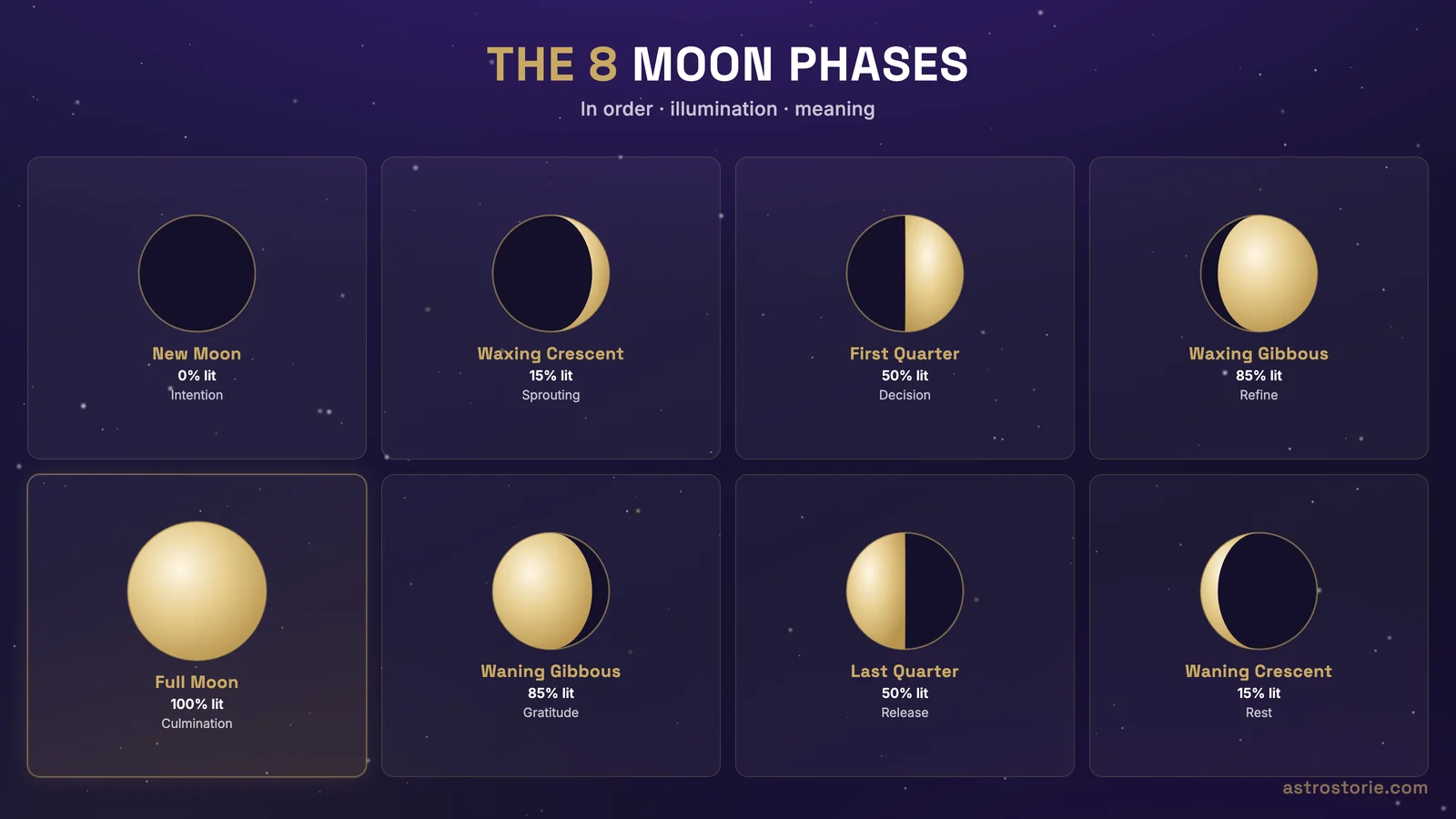
The Moon does not make its own light; it reflects the Sun, and as it circles the Earth the lit portion we can see grows and shrinks in a steady rhythm. That rhythm is the lunar cycle, and it moves through eight named phases in the same order every time. Astrologically, the cycle is a template for how anything grows: you plant at the dark of the Moon, build as the light swells, harvest at the Full Moon, and release as it fades. Below is each phase in order, its illumination, and what it asks of you.
The 8 Moon Phases in Order
| Phase | Angle | Illumination | Energy |
|---|---|---|---|
| New Moon | 0° | 0%, dark | Intention, planting, beginning |
| Waxing Crescent | ~45° | thin and growing | Nurture, first steps, momentum |
| First Quarter | 90° | 50%, growing | Decision, action, challenge |
| Waxing Gibbous | ~135° | broad and growing | Refine, adjust, prepare |
| Full Moon | 180° | 100%, full | Culmination, illumination, release |
| Waning Gibbous | ~225° | broad and fading | Gratitude, sharing, giving back |
| Last Quarter | 270° | 50%, fading | Release, clearing, letting go |
| Waning Crescent | ~315° | thin and fading | Rest, surrender, emptying |
The angle is the distance between the Moon and the Sun as seen from Earth. At 0° they sit together and the Moon is dark; at 180° they sit opposite and the Moon is fully lit. Everything else is the light travelling between those two points and back again.
The Building Half: New Moon to Full Moon
The first half of the cycle is a swelling of light, and the mood matches it: begin, feed, push.
- New Moon. The sky is dark and the slate is clean. This is the moment for setting an intention, planting a seed, starting the thing you have been circling. You cannot see results yet, and that is the point; you are planting, not harvesting.
- Waxing Crescent. The first sliver of light appears. The intention meets the real world for the first time, and so does the first resistance. Feed the new thing with small, concrete steps and do not let early doubt uproot it.
- First Quarter. The Moon is half lit and climbing fast. This is a phase of decision and friction, the astrological square, where you hit the first real obstacle and have to choose to push through. Momentum is here if you act.
- Waxing Gibbous. Almost full, the light broad and bright. Now you refine, edit, and adjust. The big moves are made; this is the phase of tightening the details and preparing for the culmination just ahead.
The Releasing Half: Full Moon to New Moon
At the Full Moon the light peaks and then begins to fade, and the whole mood turns from building to letting go.
- Full Moon. The Moon is fully lit and everything is illuminated, including what you would rather not see. This is culmination and harvest: results arrive, truths surface, emotions run high. The deeper work of the Full Moon is release, letting go of what the cycle revealed you no longer need.
- Waning Gibbous. The light starts to recede. Sometimes called the Disseminating Moon, this is the phase of gratitude and sharing, of giving back what you learned and teaching what you gained.
- Last Quarter. Half lit and fading, the second square of the cycle. This is active release: cutting what no longer serves, clearing space, forgiving, and closing what needs to close before the next beginning.
- Waning Crescent. The final thin sliver before the dark. This is rest and surrender, the exhale of the cycle. Empty out, dream, and let yourself lie fallow so the next New Moon has room to plant.
None of these phases is lucky or unlucky. The Moon is a rhythm to work with, not a force acting on you, and each phase simply favors a different kind of effort.
The Rhythm of the Cycle
Seen whole, the eight phases tell one story: intend, build, harvest, release, and rest, then begin again. The New Moon plants, the waxing phases feed and shape, the Full Moon brings the truth of the thing into the light, and the waning phases clear the field. It repeats roughly every 29.5 days, the synodic month, which is why lunar living tends to run in monthly chapters rather than the calendar’s rigid weeks.
Once you know the pattern, you can match your effort to the sky: launch and initiate on the waxing half, complete and let go on the waning half. To see which phase the Moon is in today and what it favors, check the live moon phases tracker.
Working With Each Phase
You do not need a ritual to use the cycle; you need to align your intention with the direction of the light.
- Waxing (New to Full): start, grow, pursue. Send the message, launch the project, ask for the thing.
- Full Moon: celebrate, see clearly, and release what the peak has revealed.
- Waning (Full to New): finish, forgive, declutter, and rest. A poor time to force a launch, a fine time to close a chapter.
If you want to go deeper into how the Moon shapes your inner life more broadly, your moon sign governs your emotional nature in the full natal chart. And for the exact dates of the New and Full Moons through the year, our 2026 full moon and new moon calendar tells you when each one lands.
Frequently Asked Questions
What are the 8 phases of the moon in order?
In order, they are New Moon, Waxing Crescent, First Quarter, Waxing Gibbous, Full Moon, Waning Gibbous, Last Quarter, and Waning Crescent. The first four are waxing, meaning the lit part is growing toward the Full Moon; the last four are waning, meaning the light is shrinking back toward the next New Moon. The sequence repeats in the same order every cycle.
How long is one full moon cycle?
One complete cycle, from one New Moon to the next, takes about 29.5 days. This is called the synodic month. It is slightly longer than the time the Moon takes to orbit the Earth against the stars, because the Earth is also moving around the Sun, so the Moon has to travel a little farther each cycle to catch up to the same phase.
What is the difference between waxing and waning?
Waxing means the illuminated portion of the Moon is increasing, growing from the dark New Moon toward the bright Full Moon. Waning means it is decreasing, fading from Full back to dark. Astrologically, waxing phases favor building and beginning, while waning phases favor releasing and completing. You can tell them apart at a glance: a waxing Moon is lit on the right in the Northern Hemisphere, a waning Moon on the left.
Which moon phase is best for setting intentions?
The New Moon is the traditional time for setting intentions, because it marks the start of a fresh cycle with a clean slate. Planting a clear intention at the New Moon lets you build on it through the waxing phases and see it reach a natural peak at the Full Moon about two weeks later. The Full Moon, by contrast, is better for releasing than for starting something new.
The Moon has kept the same eight-beat rhythm for as long as anyone has looked up, and once you learn it, the sky becomes a kind of clock for your own cycles. Plant at the dark, build toward the light, harvest at the peak, and let go as it fades. See what phase the Moon is in right now with the moon phases tracker, and start living in step with it.
Last updated: