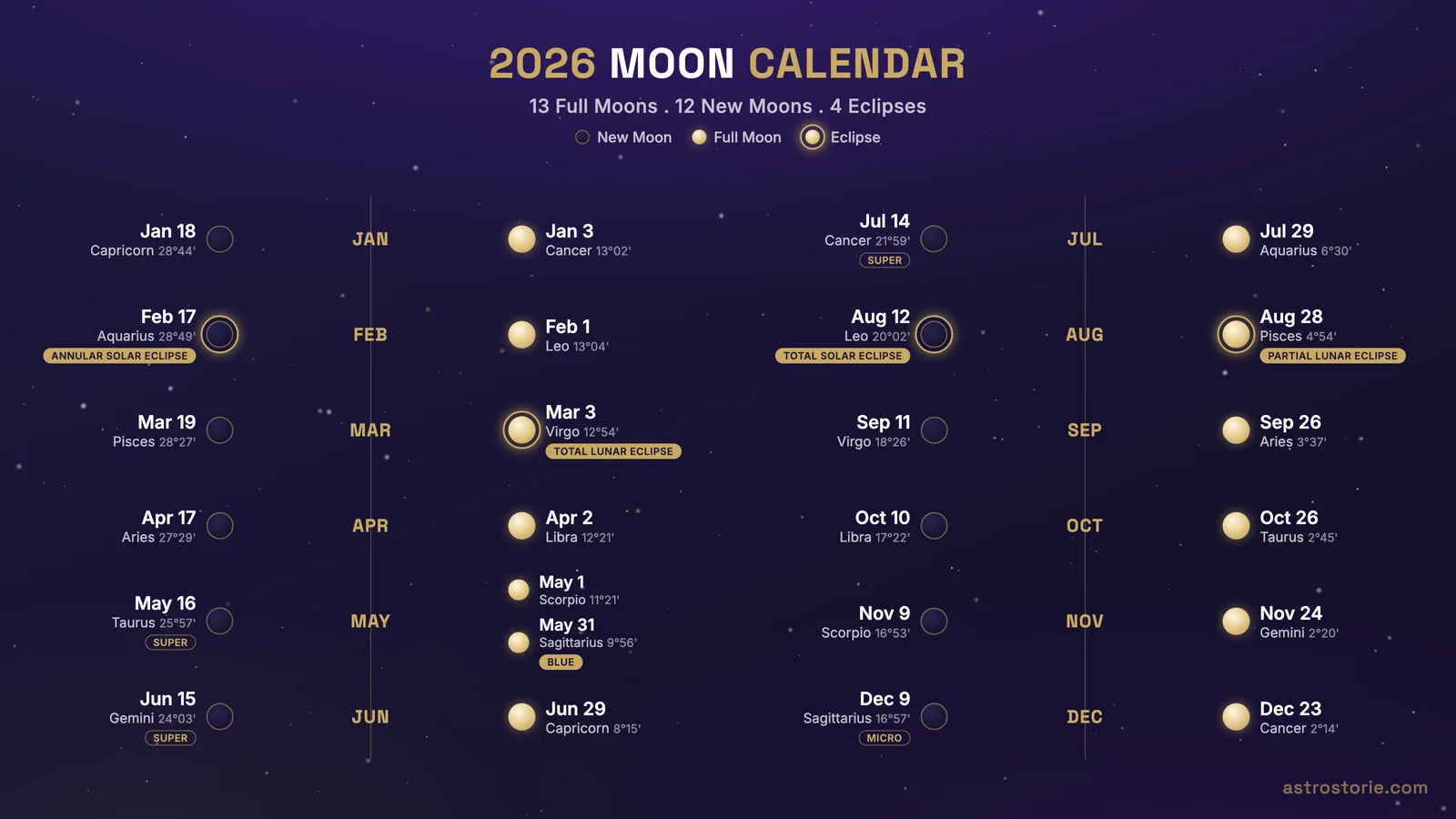
Quick Answer: In 2026 there are thirteen full moons and twelve new moons, including one blue moon in May and four eclipses. The new moon plants an intention and the full moon brings it to light, so the two halves of each cycle work as a pair. All dates and times below are given in UTC, so convert them to your own local time before you mark your calendar.
The Moon is the fastest body in the sky, and its steady rhythm of dark to full and back again is the oldest calendar humans ever kept. Each new moon opens a chapter and each full moon closes one, which is why living by the lunar cycle feels less like following a schedule and more like breathing in time with something larger. This is your complete guide to the year ahead: every full moon and new moon of 2026, the sign and degree each one falls in, the four eclipses that punctuate the year, and a simple way to work with the light as it waxes and wanes.
How to Use This Moon Calendar
Two moments anchor every lunar cycle. The new moon is the dark, seed moment, ideal for setting an intention or beginning something quietly. About two weeks later the full moon arrives, when that same theme reaches its peak of light and asks to be seen, celebrated, or released. Reading the sign each lunation falls in tells you which area of life it touches. To feel any of these more personally, it helps to know where the Moon sat at your own birth; you can find that with a moon sign calculator, and watch the whole cycle unfold in real time with the current moon phase.
Full Moon Calendar 2026
Thirteen full moons light up 2026, one more than the usual twelve, because May carries two. That second May full moon is the year’s blue moon. The table below gives each full moon in UTC, its zodiac sign and degree, its traditional name, and the theme it tends to illuminate.
| Full Moon (UTC) | Sign and degree | Traditional name | Illuminates |
|---|---|---|---|
| January 3, 10:03 | 13°02′ Cancer | Wolf Moon | Home, roots, emotional safety |
| February 1, 22:09 | 13°04′ Leo | Snow Moon | Creativity, pride, the heart’s courage |
| March 3, 11:38 | 12°54′ Virgo | Worm Moon (total lunar eclipse) | Health, work, what needs refining |
| April 2, 02:12 | 12°21′ Libra | Pink Moon | Balance, fairness, close relationships |
| May 1, 17:23 | 11°21′ Scorpio | Flower Moon | Intimacy, power, honest depth |
| May 31, 08:45 | 9°56′ Sagittarius | Blue Moon | Truth, freedom, the wider horizon |
| June 29, 23:56 | 8°15′ Capricorn | Strawberry Moon | Ambition, structure, long goals |
| July 29, 14:35 | 6°30′ Aquarius | Buck Moon | Community, ideals, breaking free |
| August 28, 04:18 | 4°54′ Pisces | Sturgeon Moon (partial lunar eclipse) | Dreams, surrender, boundaries |
| September 26, 16:49 | 3°37′ Aries | Harvest Moon | Courage, initiative, the self |
| October 26, 04:12 | 2°45′ Taurus | Hunter’s Moon | Stability, the body, what you value |
| November 24, 14:53 | 2°20′ Gemini | Beaver Moon | Ideas, conversation, curiosity |
| December 24, 01:28 | 2°14′ Cancer | Cold Moon | Home again, the year’s emotional close |
The year opens and closes in Cancer, the sign of home, so 2026 begins and ends with the same quiet question: where do you truly belong? The December full moon peaks on the 24th in UTC, which falls on the evening of the 23rd across the Americas.
New Moon Calendar 2026
Twelve new moons seed the year. Each is a fresh start in the sign it occupies, a good moment to name a wish and take a small first step. Three consecutive new moons in late spring and summer are supermoons, sitting closer to Earth and carrying a little extra pull.
| New Moon (UTC) | Sign and degree | Note |
|---|---|---|
| January 18, 19:52 | 28°44′ Capricorn | Fresh discipline, long plans |
| February 17, 12:01 | 28°49′ Aquarius | Annular solar eclipse |
| March 19, 01:23 | 28°27′ Pisces | Dreams, healing, surrender |
| April 17, 11:52 | 27°29′ Aries | Bold beginnings |
| May 16, 20:01 | 25°57′ Taurus | Supermoon: build something lasting |
| June 15, 02:54 | 24°03′ Gemini | Supermoon: new conversations |
| July 14, 09:43 | 21°59′ Cancer | Supermoon: home and belonging |
| August 12, 17:36 | 20°02′ Leo | Total solar eclipse |
| September 11, 03:27 | 18°26′ Virgo | Habits, health, order |
| October 10, 15:50 | 17°22′ Libra | Partnership, balance |
| November 9, 07:02 | 16°53′ Scorpio | Deep change, intimacy |
| December 9, 00:52 | 16°57′ Sagittarius | Micro new moon: vision, freedom |
The Four Eclipses of 2026
Eclipses are the year’s most powerful lunations, new and full moons turned up to full volume. They tend to accelerate endings and beginnings, so the themes of the signs they fall in arrive quickly rather than gently. In 2026 the four eclipses cluster in two seasons, late winter and late summer.
| Date (UTC) | Type | Peak (UTC) | Sign | Where visible |
|---|---|---|---|---|
| February 17 | Annular solar | 12:12 | 28°49′ Aquarius | Antarctica, southern skies |
| March 3 | Total lunar (blood moon) | 11:33 | 12°54′ Virgo | Americas, Pacific, East Asia |
| August 12 | Total solar | 17:45 | 20°02′ Leo | Greenland, Iceland, Spain |
| August 28 | Partial lunar | 04:13 | 4°54′ Pisces | Americas, Europe, Africa |
The total solar eclipse of August 12 is the headline event, a rare daytime darkness sweeping across Greenland, Iceland, and northern Spain. Falling in proud, radiant Leo, it invites a bold new chapter of self-expression for anyone willing to step into the light.
The Blue Moon, Supermoons, and the Micromoon
A few lunations in 2026 stand apart. The blue moon on May 31 is simply the second full moon in a single calendar month, a rare guest that folklore ties to once-in-a-while chances, and in restless Sagittarius it favors a leap toward something more honest and free. The supermoons at the new moons of May, June, and July sit near their closest approach to Earth, lending those fresh starts extra weight. And the micromoon at the December 9 new moon is the opposite, a new moon at its farthest, a quiet, small-voiced invitation to dream inward before the year turns.
New Moon Intentions and Full Moon Release
Working with the Moon is less about ritual perfection than about rhythm. A simple practice carries you through the whole year.
At the new moon, write down one or two intentions in the area the sign governs. Keep them modest and specific, plant them like seeds, and let the coming two weeks be about small, patient steps rather than instant results.
At the full moon, return to what you named at the new moon and notice what has grown. This is the moment to celebrate progress, or to release what is not serving you: a habit, a resentment, a plan that has quietly expired. The full moon’s light is honest, and it makes letting go easier.
Followed month after month, this two-beat rhythm turns the calendar above into something you live rather than merely read. Watch the Moon’s current phase to know exactly where you stand in the cycle on any given night.
Frequently Asked Questions
How many full moons are there in 2026?
Thirteen, one more than the usual twelve, because May holds two full moons. The second of them, on May 31, is a blue moon. The extra full moon happens whenever a calendar month is long enough to contain two complete full phases.
When is the blue moon in 2026?
The blue moon falls on May 31 at 08:45 UTC, at 9°56′ Sagittarius. It is called blue because it is the second full moon within the single month of May, not because of any change in color. The previous full moon, the Flower Moon, arrives on May 1.
How many eclipses happen in 2026?
Four: two solar eclipses and two lunar eclipses. The solar eclipses are an annular eclipse on February 17 in Aquarius and a total eclipse on August 12 in Leo. The lunar eclipses are a total eclipse on March 3 in Virgo and a partial eclipse on August 28 in Pisces.
What is the difference between a new moon and a full moon?
A new moon is the dark point of the cycle, when the Moon sits between the Earth and the Sun and its lit face turns away from us. It is a time for beginnings and intentions. A full moon is the opposite point, when the Moon is fully lit, a time of culmination, visibility, and release.
Why does the moon calendar use UTC?
Because the Moon reaches each exact phase at one single instant worldwide, and UTC is the neutral reference for that instant. A full moon listed at 01:28 UTC may fall on the previous evening in the Americas or later the same day in Asia, so converting to your own time zone keeps your dates accurate.
How do I know which full moon matters most for me?
The lunations that fall on or near your personal placements land hardest. Knowing your own Moon sign is a good start, and you can find it with a moon sign calculator. A full moon in your Moon sign, or in the sign opposite it, tends to feel especially vivid.
The Moon has kept time for every generation before this one, and in 2026 it offers the same steady invitation it always has: to begin at the dark, to bloom at the full, and to let go before you begin again. Mark the dates, notice which signs stir something in you, and let the cycle become a rhythm you move with. Thirteen times the light will fill, and thirteen times it will teach you how to release, until the year closes where it opened, in the quiet waters of Cancer.
Last updated: